





Free guide · 2027 edition
For a country of a few million people, Scotland has given the world a remarkable number of ideas: the telephone and television, anaesthesia and ultrasound, the steam engine, logarithms and modern economics. Our guide tells their stories, and where to see them in Scotland today.
Download the free guide11 pages, sent straight to you as a PDF
Alexander Graham Bell, born in Edinburgh in 1847, was granted the American patent for the telephone in March 1876.
John Logie Baird, born in Helensburgh, gave the first public demonstration of television in January 1926.
James Clerk Maxwell demonstrated three-colour photography in 1861, using a tartan ribbon.
Sir David Brewster, born in Jedburgh, invented and patented the kaleidoscope in 1817.
Sir Robert Watson-Watt’s team showed in 1935 that radio waves could detect an aircraft.
Sir James Young Simpson, born in Bathgate, tested it on himself and his friends in 1847.
Eleven illustrated pages, in seven chapters and a map.
Some were invented here; others by Scots working abroad. The guide says which, and avoids claiming more than the evidence supports.
From a lighthouse signal tower in Arbroath to a famous sheep in Edinburgh, we build private journeys around the places where these stories happened.
Download the free guidePrivate journeys through Scotland,
and the world of Scotch whisky.
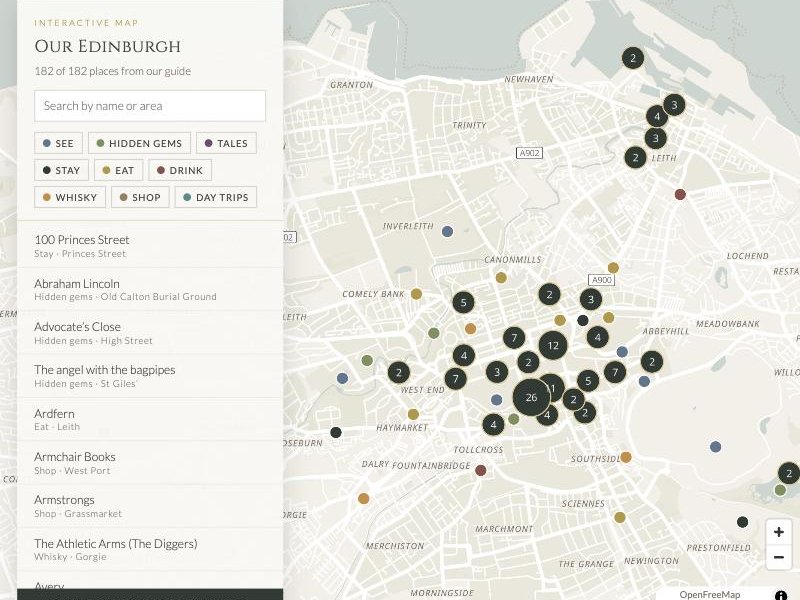 Explore our Edinburgh map →
